Human action to save the ozone layer has worked as hoped, and it may recover in just decades, the UN says.
An international agreement in 1987 to stop using the harmful chemicals that were damaging the layer has been successful, the major assessment says.
The ozone layer is a thin part of the Earth’s atmosphere that absorbs most of the ultraviolet radiation from the Sun.
When it is depleted, this radiation can reach the surface – causing potential harm to humans and other living things.
Ultraviolet rays can damage DNA and cause sunburn, increasing the long-term risk of problems such as skin cancer.
The ozone layer began depleting in the 1970s.
Chlorofluorocarbons (CFCs), which were commonly found in spray cans, fridges, foam insulation and air conditioners, were blamed for eating away at the ozone layer.
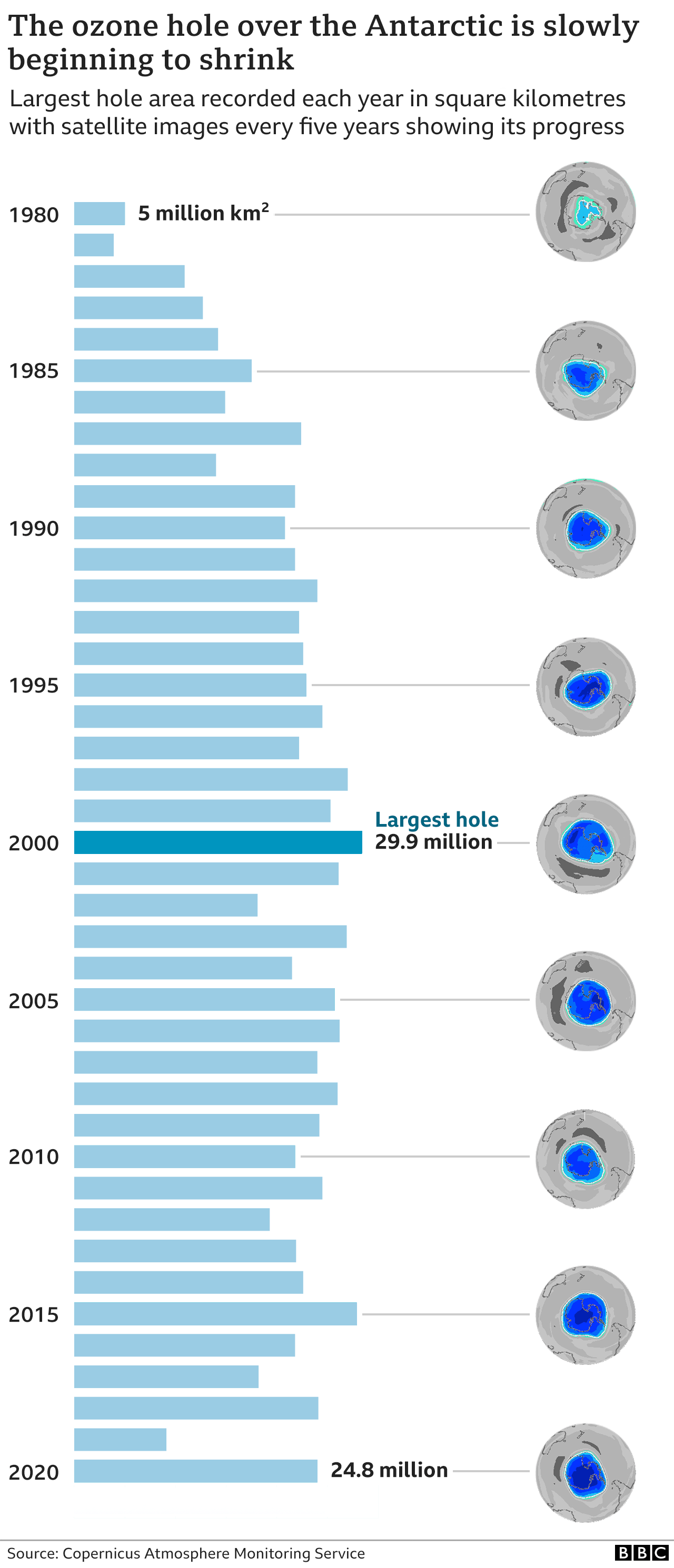
A gaping hole in the layer was discovered by scientists in 1985. Just two years later, the Montreal Protocol was signed – with 46 countries promising to phase out the harmful chemicals.
The deal later became the first UN treaty to achieve universal ratification, and almost 99% of banned ozone-depleting substances have now been phased out.
The Antarctic ozone hole continued expanding until 2000, after which its area and depth began improving slowly.
Now, a report co-produced by UN, US and EU agencies says the Montreal Protocol is working as hoped.
It says that, if current policies are maintained, the ozone layer will be restored to 1980 values – before the ozone hole appeared – at different points in different places:
- 2066 over the Antarctic, where ozone depletion was the worst
- 2045 over the Arctic
- in about two decades’ time everywhere else
While the depletion of ozone is harmful due to solar radiation, it is not a major cause of climate change.
But saving the ozone layer has had a positive knock-on effect on global warming, the report suggests, because some of the harmful chemicals that were phased out are powerful greenhouse gases.
That phase-out will have prevented up to 1C of warming by the middle of the century – if compared to increasing their use by 3% per year, the scientists found.
While the report has been hailed as good news – and evidence that rapid, international action to avert environmental crises can work – it warns that continued progress on the ozone layer is not guaranteed.
For example, proposals to limit global warming by sending millions of tonnes of sulphur dioxide into the upper atmosphere – known as stratospheric aerosol injection- could drastically reverse the ozone layer’s recovery.